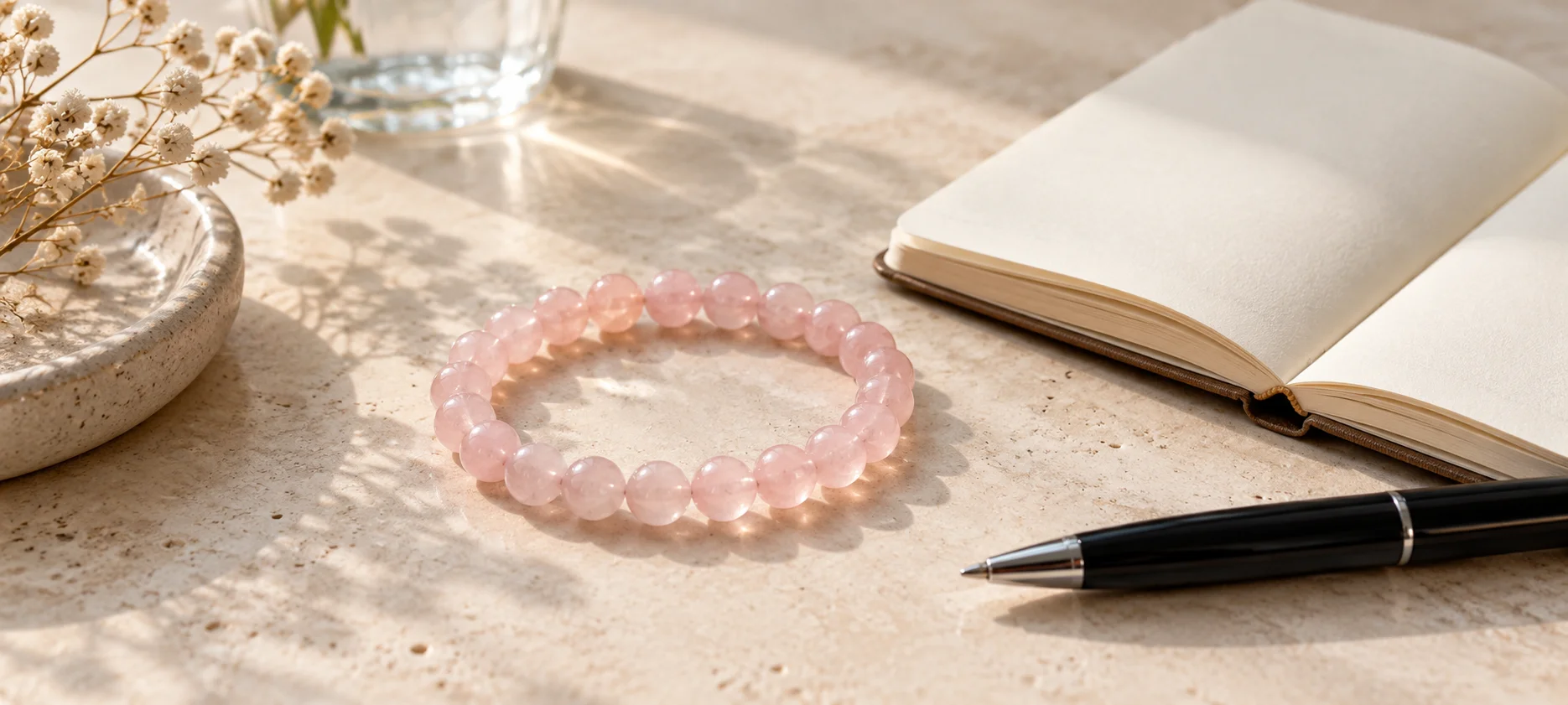
To be honest, I think crystal bracelets get asked to do way too much.
They’re supposed to look good, attract love, help with career breakthroughs, and somehow explain why one Tuesday felt luckier than the last.
The reasons for keeping one can be much simpler.
You like the color. It was a gift from someone you miss. You bought it the week you started a new job, and now it just belongs to that memory.
At Lychee Vibes, every bracelet comes with a Chapter Card so you can write down an intention. The idea is pretty straightforward: choose something you actually enjoy wearing, and give it a meaning you can come back to. The writing part matters as much as the jewelry itself.
When good luck gets attached to a bracelet
Picture this: you wear a new pink bracelet to a café and end up talking to someone you like. They ask for your number. Later, when you look at the beads, that afternoon comes back.
It’s a nice association. But a lovely memory attached to a bracelet is different from proof that the stone somehow brought the person into your life.
The same thing happens with work. A contract signed on the day you happened to wear a certain bracelet may have followed months of emails, revisions, and follow-ups. The bracelet is easy to notice. All the actual work is easier to leave out of the story.
I’d rather give credit to the person who kept following up. They earned it.
There’s also another problem with calling jewelry “lucky.” If the bracelet gets credit when things go well, it can just as easily get the blame when they don’t. Neither outcome really tells us the stone changed anything.
A meaning, a little like flowers
Think about giving someone flowers. The choice of flowers, the occasion, the little note — all of that shapes what the gift means.
A bracelet can carry a similar personal message. Given before a friend moves away, it might simply mean “I’m glad we had this time.” Bought after finishing a long project, it might mark the night you finally stopped working and went out to celebrate.
The meaning doesn’t have to stay fixed forever. A piece you originally chose just because it looked good can later become the one you associate with a particular person or season of your life.
The beads themselves
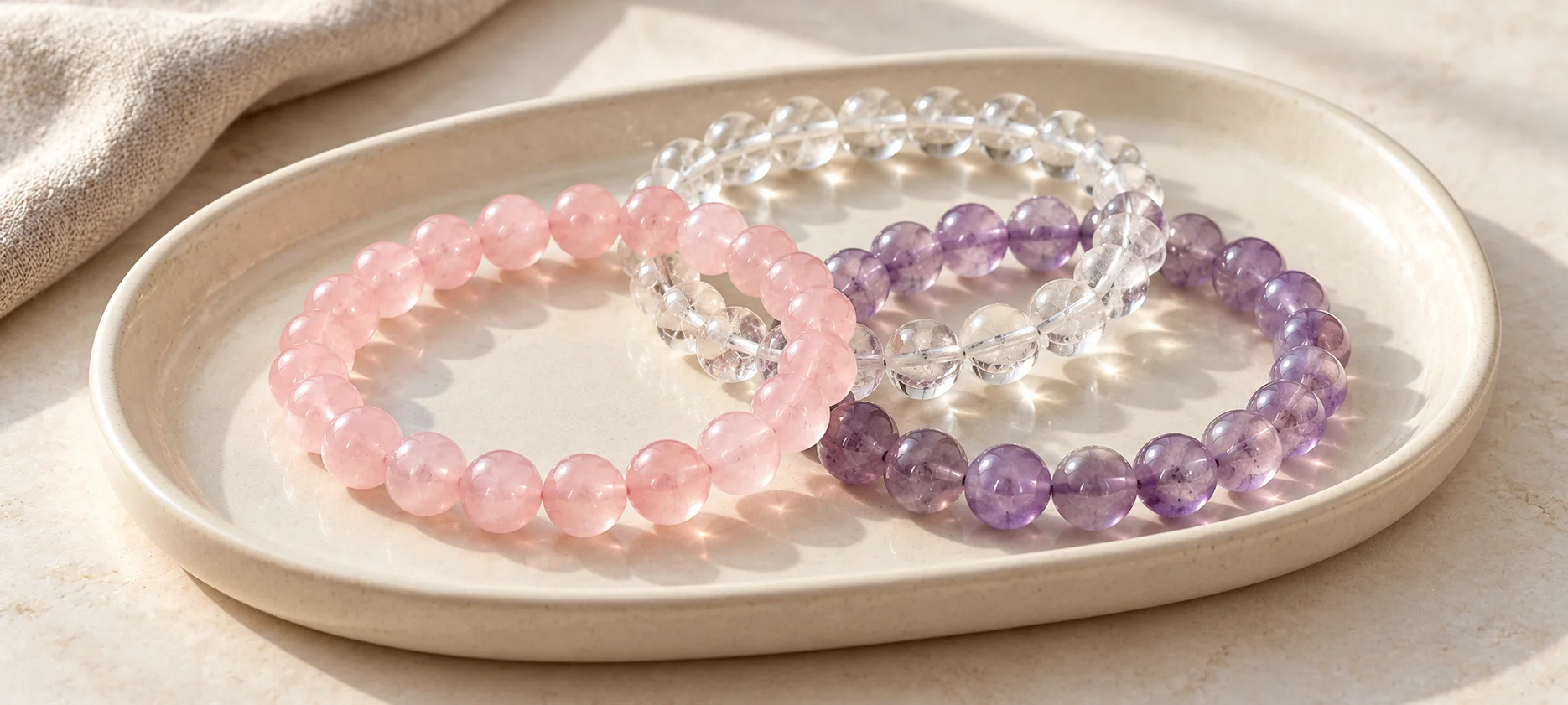
Before any symbolism, there’s the actual object. The milky patches inside a rose quartz bead, the way light moves through clear quartz, how a darker bracelet sits against an ivory sleeve.
Touch matters too. Round beads have weight and shift against the skin. Some people like turning them between their fingers; others just notice how they catch the light as the wrist moves.
For me, appearance and feel should come first. A nice meaning written on a product page isn’t enough reason to buy something you’d otherwise leave in a drawer.
What would you like it to remind you of?
An intention is easier to act on when it names something concrete.
“I want to make more time for my friends” could mean actually sending the invitation instead of leaving another vague “we should catch up soon.” You might choose to use the moment you put the bracelet on as your cue to text someone about coffee this weekend.
For a new job, it might be: “I want to share one idea in the next team meeting.” Before the meeting starts, you glance at the bracelet and quickly review the point you prepared.
Writing the sentence down gives you something specific to return to later. A few months on, the bracelet might remind you of that first meeting, or the friend you started seeing more often. You end up with a small story about what you actually did — and a piece of jewelry that belongs to it.